
India, China discuss ways to maintain peace along LAC, delimitation of frontier
August 26, 2026 | Author: News Desk
BEIJING, Aug 25: India and China on Tuesday discussed ways to maintain peace and stability along the Line of Actual Control (LAC) and to move toward progress on delimitation of the frontier, while sustaining ongoing work on trans-boundary cooperation, as National Security Advisor Ajit Doval held extensive talks with Chinese Foreign Minister Wang Yi.
Held under the framework of the Special Representatives dialogue, the Doval-Wang talks came weeks before Chinese President Xi Jinping’s anticipated visit to India for the upcoming BRICS summit.
In his opening remarks at the meeting, Doval said that normalcy in the ties between India and China has been a direct result of both sides maintaining peace and tranquillity in the border areas.
“The two sides positively reviewed the ongoing momentum in bilateral relations which is in line with the directions and vision of Prime Minister Narendra Modi and President Xi Jinping,” the Indian embassy in Beijing said.
“They discussed ways to further expand bilateral cooperation, maintain stability and ensure peace and tranquillity in the border areas, and make progress on boundary delimitation, while sustaining the ongoing work on transboundary cooperation,” it said.
The Special Representatives (SR) dialogue took place amid reports of aggressive military posturing by Chinese troops along the LAC in the Upper Subansiri region of Arunachal Pradesh.
Doval landed in Beijing on Monday on a two-day visit and his trip is largely seen as part of ongoing efforts by the two neighbours to rebuild their relationship after it came under severe strain following the deadly Galwan Valley clashes in 2020.
“I am very happy we are here for the 25th round of talks which are very important, particularly in the wake of the BRICS summit to happen shortly,” Doval said.
“We meet in keeping with the guidance of our leaders, Prime Minister Narendra Modi and President Xi Jinping, who have given clear and positive direction to our relationship both at Kazan and Tianjin,” Doval said, referring to the meetings the two leaders held on the sidelines of the BRICS summit in Russia in 2024 and the SCO summit in China last year.
Referring to progress made by the two sides in normalising the ties following the eastern Ladakh military standoff, Doval said the bilateral relationship has been steadily returning to normalcy.
“The normalcy we have witnessed in our relationship has been a direct result of both sides maintaining peace and tranquillity in the border areas,” he said.
“We have extensively talked about it today just to see how to effectively reinforce and further consolidate our efforts to maintain peace and tranquillity in the border areas,” he said in an apparent reference to differences over the border and Arunachal Pradesh, which China claims as South Tibet.
Doval also talked about advances made by the two countries in improving people-to-people ties.
“The successful conduct of Kailash Manasarovar Yatra via Nathu La and resumption of our traditional border trade via all the three passes brought tangible benefits for our people, particularly people living in the border areas,” he said.
In his remarks, Wang said the China-India relationship has gone beyond the bilateral scope and taken on global and strategic significance.
“It is important for us to step up communication, to enhance mutual trust, to remove disturbances and overcome obstacles. We need to be good friends that enjoy good neighbourliness and be good partners that contribute to each other’s success,” he said.
Wang also talked about adding new impetus to the ties during the talks with Doval.
He reiterated that China and India should draw lessons from history, place the boundary question appropriately in bilateral relations, and keep moving forward without stagnating, backtracking or veering off course.
Wang called for gradually building a positive narrative on China-India boundary affairs, making dialogue, peace, consultation and cooperation the mainstream and injecting positive factors into the sound and stable development of bilateral relations, a statement on the talks issued by the Chinese Foreign Ministry said.
“I look forward to continuing to have in-depth exchange of views with you on issues of shared interest to better understand each other and to properly handle the boundary question, to not only maintain peace and tranquillity in the border area but also inject new impetus for the bilateral relationship,” he said.
Wang also said the two sides have stayed in regular communication through diplomatic and military channels on boundary affairs, implementing the guidance of PM Modi and President Xi.
Terming his talks with Doval as “very in-depth and candid,” the Chinese minister expressed hope to reach a new consensus.
The Chinese statement said the two sides held in-depth discussions on advancing border delimitation negotiations, strengthening border management and control, improving mechanism-building and promoting cross-border cooperation.
Both Doval and Wang are the designated SRs for the boundary talks mechanism, which was established in 2003 to comprehensively address the dispute of the India-China border spanning 3,488 km.
While success eluded it in resolving the boundary dispute, officials on both sides regard the structured mechanism as a useful tool in addressing the recurring tensions between the two countries on various fronts.
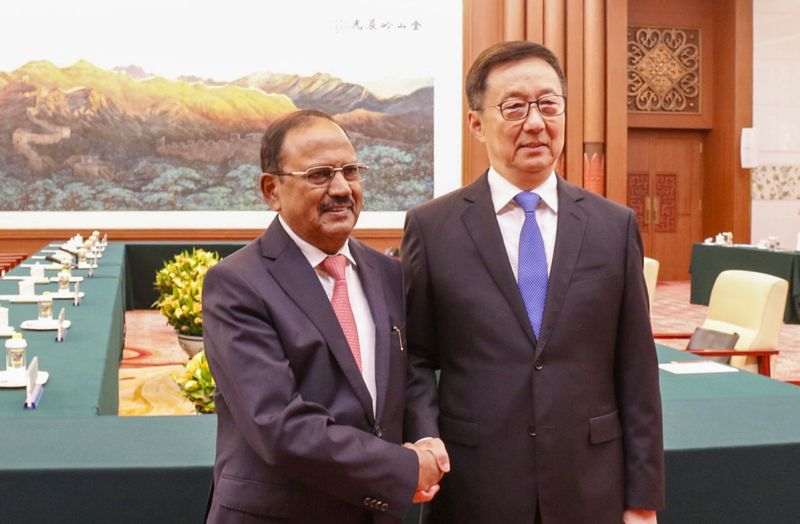
Ahead of the talks, Doval called on Chinese Vice President Han Zhang.
The two leaders discussed ways to strengthen peace and tranquillity in the border areas and further improve bilateral ties across economic, political and multilateral fora, in accordance with the consensus reached between the leaders of the two countries, the Indian Embassy said in a post on X.
During his meeting with Doval, Han said China and India should view and handle bilateral relations from a strategic and long-term perspective, and work together to implement the important consensus reached by their leaders.
“The two sides should enhance strategic mutual trust, tap the potential for cooperation, maintain close multilateral coordination, properly manage differences, and promote the sustained and stable development of China-India relations,” Han was quoted as saying by the state-run Xinhua.
In August last year, China and India successfully held the 24th round of talks, during which the two sides had candid and in-depth exchanges of views on the boundary question and reached a number of common understandings.